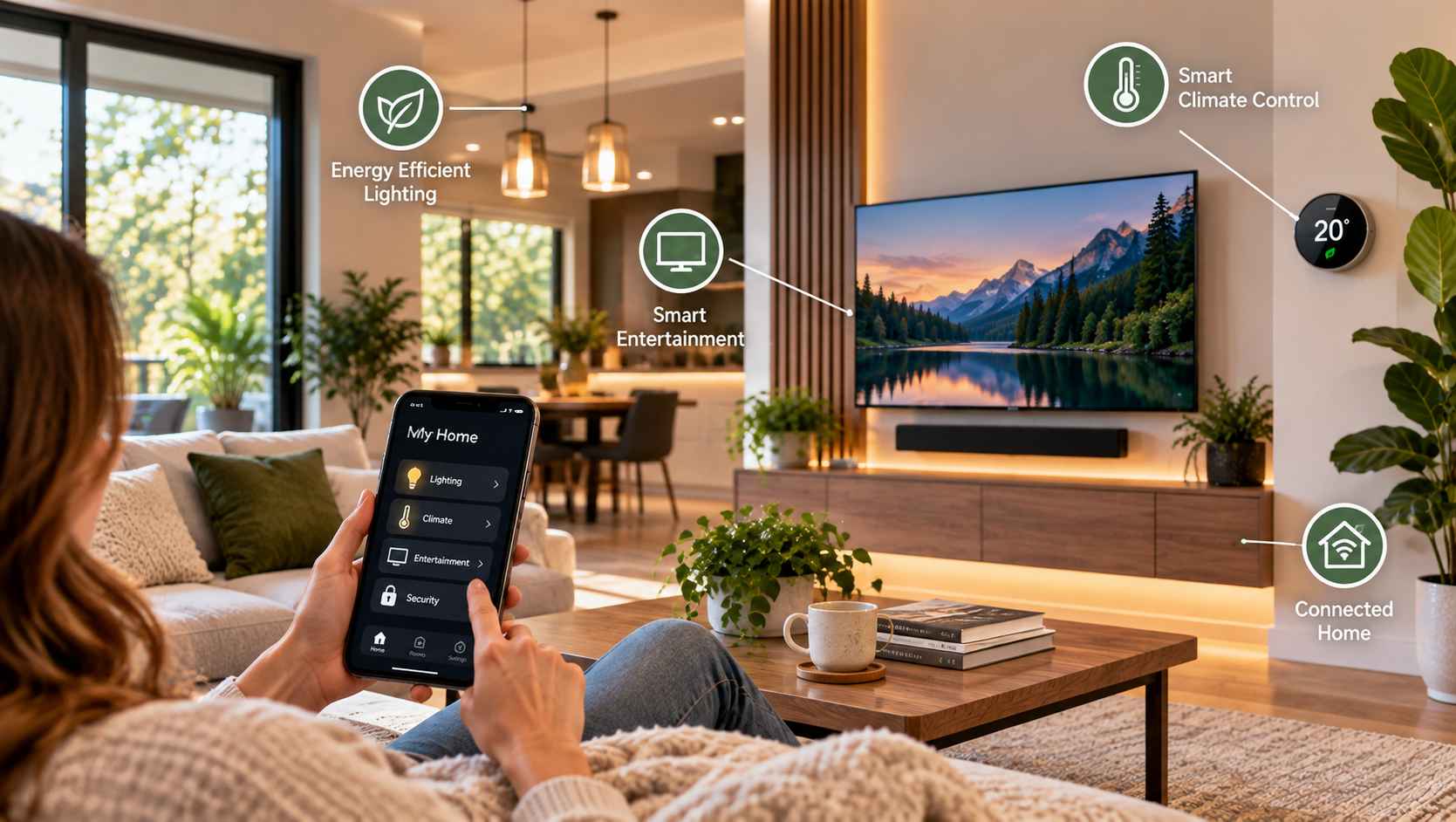
A connected home can either simplify daily life or add another layer of devices, apps, remotes, and equipment to manage. The difference often comes down to how the technology is planned and used.
Smart home technology does not automatically make a household more sustainable. Adding more connected devices can create more equipment and energy demand if those devices are poorly selected or left running unnecessarily. But when technology is introduced with a clear purpose, it can help homeowners manage lighting, climate, entertainment, and other routines more thoughtfully.
The goal is not to automate everything. It is to use technology where it can make everyday household decisions simpler and more consistent.
Start With the Household’s Actual Needs
The most efficient smart-home setup begins with a practical question: what does the household actually need?
A homeowner may want better control over lighting, easier management of entertainment equipment, or a simpler way to adjust the environment when leaving the house.
Those needs are more important than the number of smart devices installed.
For example, automatically turning lights off in unused areas can be useful. Creating complicated automation for rooms that are rarely occupied may add complexity without much benefit.
A thoughtful system focuses on routines that happen regularly and gives homeowners an easy way to adjust or override them when necessary.
Use Lighting More Intentionally
Lighting is one of the most accessible areas for smart-home control.
Schedules, dimming, occupancy-based controls, and centralized settings can help homeowners avoid leaving lights on unnecessarily. They can also make lighting more comfortable by allowing different levels to be used for different activities.
A kitchen may need brighter lighting during meal preparation but softer lighting later in the evening.
A hallway may not need to remain fully illuminated throughout the night.
Instead of treating every light as a simple on-or-off device, homeowners can think about when lighting is actually needed and how much illumination is appropriate.
The environmental benefit depends on how the system is configured and how people use it. Automation is simply a tool that can make more deliberate habits easier to maintain.
Consider Smart Climate Control
Heating and cooling are another area where thoughtful control can support household efficiency.
A smart thermostat can make it easier to establish schedules around a household’s daily routine. Rather than maintaining exactly the same settings at all times, homeowners can consider how the home is actually occupied.
For example, a household may have different needs while everyone is asleep, away during the day, or spending time at home.
The right settings will vary by home, season, occupants, and comfort preferences.
Technology should support those decisions rather than encouraging homeowners to constantly adjust settings simply because an app makes it possible.
Reduce Unnecessary Entertainment Equipment Use
Entertainment systems can involve several devices, including displays, speakers, receivers, streaming equipment, game consoles, and networking components.
When these systems are assembled separately, it can become easy to leave equipment powered unnecessarily or forget which components need to be active.
Centralized control can make everyday operation simpler.
A homeowner may be able to create a straightforward routine for watching television, listening to music, or shutting down an entertainment setup when it is no longer being used.
This does not mean every device needs to be automatically switched off at every opportunity.
The more useful approach is to understand which equipment needs to remain active and which components can reasonably be powered down when they are not needed.
Think About One System Instead of Many Separate Devices
A household can quickly accumulate smart bulbs, speakers, thermostats, televisions, switches, sensors, and other connected products.
Individually, each device may seem useful.
Collectively, however, they can become difficult to manage if every product has a separate application or control method.
Integration can help reduce that fragmentation.
Rather than managing lighting, entertainment, networking, and other connected devices as completely separate systems, some homeowners may explore smart home solutions from Signature Audio Video when planning a more coordinated setup.
The important consideration is not simply how many systems can be connected. It is whether bringing them together makes everyday use easier and more purposeful.
Create Simple Scenes for Everyday Routines
One useful feature of an integrated system is the ability to combine several actions into a single routine.
A “movie” setting, for example, might adjust appropriate lighting while preparing the entertainment system for use.
An “away” routine might help ensure selected lights and equipment are not left operating unnecessarily.
A “morning” setting could adjust lighting or other connected systems according to the household’s routine.
These scenes are most useful when they reflect activities people actually perform.
There is little value in creating dozens of complicated settings that household members rarely use.
A small number of well-designed routines can be easier to understand and maintain.
Plan Technology Before Renovation Work
Technology becomes easier to integrate when it is considered before walls, ceilings, cabinetry, and other finishes are completed.
This is particularly important for homeowners planning renovations.
Cable routes, speaker locations, equipment storage, power requirements, networking, lighting controls, and display placement can all influence the final result.
Planning early can also reduce the temptation to add visible equipment wherever an outlet happens to be available.
The objective is not to predict every future device.
It is to create enough flexibility that technology can be updated without unnecessarily disrupting the finished space.
Think About Equipment Longevity
A more sustainable approach to home technology is not necessarily about buying the newest device every year.
It can also involve selecting systems that are useful for a longer period and can adapt as household needs change.
When planning a connected home, homeowners can consider whether a system can accommodate future changes.
Will additional equipment be easy to integrate? Can the network support future household needs? Is there an accessible location for central equipment?
Adaptability can reduce the need to redesign an entire setup simply because one part of the system changes.
Avoid Automation for Automation’s Sake
It is easy to become attracted to smart-home features because they are available.
But convenience should have a purpose.
A connected device that performs a useful recurring task may be worthwhile. A device that adds another application, subscription, charger, or maintenance requirement without solving a real household problem may not be.
Before adding another smart product, consider what it is expected to improve.
Will it reduce unnecessary activity? Make a routine easier? Improve control? Replace an awkward manual process?
If the answer is unclear, there may be little reason to add it.
Consider the Whole Home
Efficiency is easier to manage when homeowners think about the property as a connected environment rather than a collection of individual rooms.
Lighting, climate control, entertainment, networking, and other systems can influence how people use their spaces.
An open-concept home may require different thinking from a house with many separate rooms.
A family that spends most of its time in a few common areas may have different priorities from a household where people regularly work, study, and relax in different parts of the property.
The technology plan should reflect those patterns.
Keep Manual Control Available
Smart technology should make life easier, not make homeowners dependent on automation for every ordinary task.
There should generally be straightforward ways to operate important systems manually when needed.
This matters when a schedule needs to be changed, a sensor behaves unexpectedly, a guest uses the room differently, or a household routine changes.
Good technology planning leaves room for human decisions.
Automation works best as support rather than as a rigid replacement for common sense.
Make Smart Technology Part of the Design
Connected technology is easier to live with when it fits naturally into the physical environment.
Speakers can be considered alongside furniture placement. Displays can be planned around sightlines and natural light. Networking equipment can have a dedicated location. Lighting controls can be positioned where they are intuitive to use.
The same principle applies to visible cables and equipment.
A clean installation does not necessarily mean hiding everything. It means deciding deliberately where technology belongs instead of allowing devices and wires to accumulate wherever there is available space.
Review the System as Household Needs Change
A smart-home setup should not be considered finished forever.
Families change. Rooms change purposes. Children grow older. Work arrangements change. Entertainment habits evolve.
A room that was once primarily used for television may become a home office or shared living space.
Reviewing the technology occasionally can help homeowners remove devices they no longer use and adjust routines that no longer fit.
This is also an opportunity to simplify.
Removing unnecessary equipment can be just as valuable as adding a new feature.
Use Technology Intentionally
Smart-home technology can support a more efficient household, but the technology itself is not the solution.
The real benefit comes from thoughtful choices.
Use automation where it addresses a genuine routine. Schedule lighting according to actual needs. Manage climate settings around occupancy and comfort. Avoid leaving unnecessary entertainment equipment running. Plan networking and equipment locations before renovations. Choose systems that can adapt rather than constantly replacing disconnected devices.
Most importantly, keep the household’s habits at the centre of the plan.
A well-designed smart home should not feel like a collection of gadgets competing for attention. It should make everyday routines simpler, reduce unnecessary effort, and give homeowners better control over the way their spaces operate.
That kind of technology is not about having more devices. It is about making the devices that are already part of the home work together more thoughtfully.